ABSTRACT:
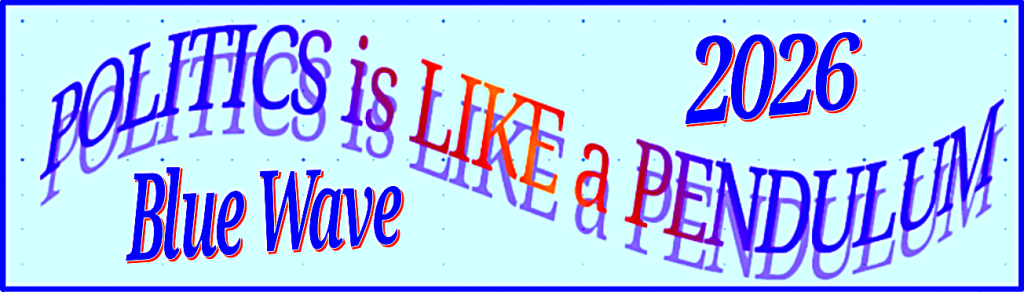
Democratic Strategists should invoke “the Political Pendulum” metaphor as a Campaign Slogan for the 2026 Mid-Term and 2028 Presidential Elections. Furthermore, the Democrat Strategists should co-opt the “Albert Einstein” version rather than the Arthur Schlesinger phrase-ology of that metaphor. The “Pendulum metaphor” can and should be enhanced with “Blue Wave” imagery. The pendulum metaphor emphasizes that a “swing” to collaboration of disparate proclivities resulting in harmonious congruence is an inevitable outcome that will surpass the prospect of fear and authoritarian oppression.
BACKGROUND:
The concept that “politics is like a pendulum” refers to a theory in which political power, public mood and policy decisions oscillate between opposite extremes such as liberal and conservative over time.
The pendulum model was popularized by historian Arthur M. Schlesinger Jr. It suggests that when a governing ideology overreaches, it inevitably triggers a reaction that swings the “pendulum force” inherent in the voting population in the opposite direction. Also implied in the pendulum metaphor is that there is an “inexorable correcting or over-correcting” and “revisionist backtracking” in a democracy. Under normal circumstances, a center ideology holds with trans-formative progress for the quality of life. But these days of MAGA and Trump cannot be considered to be normal circumstance.
Albert Einstein purportedly re-phrased the Pendulum Metaphor in an eerily relevant comment for these days: “Politics is a pendulum whose swings between anarchy and tyranny are fueled by perrenially rejuvenated illusions”. Einstein’s contended that while one could master the physical processes of this universe perhaps with equations, “Politics is more difficult than physics”. He viewed politics as a difficult to predict and sometimes dangerous human endeavor. This cynical viewpoint reflects the consideration that extreme fluctuations in political voting trends are facilitated by illusions or false beliefs held by the general public about power, government and social structure. It implies that a voting public under duress due to oppressive government has too many influences from ideological dominant narratives to make rational decisions. These conjectures certainly seem to be relevant factors for the upcoming Mid-Term 2026 Elections in the United States. See the RECAPITULATION section for more details about the legacy of Einstein, his political views, and this attributed quote.
CONSIDERATIONS
The “Politics Swings like the Pendulum Do” metaphor speaks to the masses, there is a certain candor about its truthfulness, even if it is a trite-ism. In this day and age of the 140 character tweet, here are 36 characters. The full Einstein Quote runs 111 characters. “Politics is like a Pendulum”: perfect for flyer logos and bumper stickers at 27 characters.
In a day and age in which the opponent appeals or otherwise manipulates the working class to vote against their own best interests, a Pendulum slogan would instill a sense of rebelliousness and hopefully a resolve to assert themselves as part of the solution rather than the problem.
Regretfully, we are not talking rocket science here. There has been distinct dumbing-down of America, especially since AI infested everyone’s phones. The Class of 2020 did not even go to school. Sorry again, but the Pendulum Metaphor explains politics in terms a sixth grader could understand.
What better spokesman, even if it is a co-opted quote, could there be than Albert Einstein? Even if the direct quote is not used, the attribution could. The average voter would be exhilarated to think that the same genius who gave us the theory of relativity has something to say about politics in their lives.
It is recognized that the Pendulum Metaphor is an oversimplification, and in a big way. There has been criticism in the past from political analysts that the forces on such a pendulum would come from many directions and not just left and right ideologies. The pendulum effect, when properly understood as vibratory phenomenon having both frequency and wave-length, this and other criticisms become moot.
The pendulum does not always swing back to the exact same middle point. As it moves, an unstable center moves with it, meaning each swing begins in a new place, often leading to a “ratchet effect” where changes are hard to reverse. Conversely, the center is being transformed and marks progress.
The public voting reaction to a political ideology or domestic policy is not always equal and opposite. While some impertinent changes and recriminations may become permanent, the pendulum effect acts as an important check and balance system. Overall, enduring policy shift becomes the will of the people, the original intent of the United States Constitution.
The rise of the MAGA movement has challenged the traditional, predictable swing of the pendulum. Observers note this movement is more of a cultural, populist, and cult-like tribal entity than traditional conservatism, making it more resistant to the typical political tides. However, that too is changing.
Politics now seem to move faster than in the past, with rapid, intense back-and-forth swings between administrations. Some analysts argue that when the pendulum swings very far to one side, it doesn’t just return to the center, but rather swings with significant momentum to the opposite extreme.
Following the 2020 election of moderate Joe Biden, the 2024 election saw the political pendulum swing back to the right with Donald Trump, deepening the MAGA grip on the Republican Party.
Critics argue that the metaphor implies a harmonious and balanced movement that cannot exist in the current polarized environment, which some feel is more of a chaotic and rapid shifting towards autocracy. This vadid point brings in the context of ideological subterfuge perpetrated b MAGA.
Republicans are already seeing their success from 2024 triggering a backlash, as early upsets signal how quickly voters can turn against the party in power. Further news cycles involving the use of US military in our cities during peacetime and of incidents involving ICE are driving voter reactions.
Being angry is a great mobilizing force. When people are upset, they’ll go to the polls and try to vote for change. It may not be a pendulum after all: it is the voters who are mobilizing and their reaction to the outrageous breaches of common decency that the MAGA regime is imposing on all Americans.
There exists a common folk belief in the cyclical nature of politics. A vociferous campaign slogan is needed which emphasizes or at least implies that there may be an inexorable force to counter the ideological subversion from right wing think tanks like the Heritage Foundation.
The political party not in power is always most vocal in the off-election years. The necessity for a swing from ultra conservative to populist liberal fosters a call to action by Democrats. Republican ideologues will grow to rue the day when they first heard about The Pendulum and the Blue Wave.
“BLUE WAVE” IMAGERY
There is a basic logical flaw inherent in many of the criticisms of the political pendulum cncept. Many criticisms can be explained away by enhancing the basic, common conception of a back and forth swinging pendulum, like on a grandfather clock. In today’s relativistic world, there is a range of counterpoints, not merely just one extreme. Pendulums undergo oscillations in three dimensions, they scribe out circles, figure eights, and what is more: wave-forms. Not only that, there is more than just one pendulum, and each of those numerous pendulums operates at a different frequency, and has a different wavelength. This is how the complexities of today’s chaotic political world coalesce into a harmonious coherence: through interaction in the same manner scattered light focuses into a laser.
There is a physics toy which is popular with the do-it-yourself crowd on YouTube called the WAVE PENDULUM. It consists of a series of balls strung to a frame similar to a NEWTON’S CRADLE, but the length of the strings has been arranged log-rhythmically such that each one swings at a different frequency. When set into motion, the balls course out all kinds of beautiful and hypnotic patterns.
Getting back to the analogy of this Blue Wave Pendulum, Politics and the voting public. With the appropriate enhancements, and by “relativizing” the conception of a pendulum, there can be a clear-cut representation of each person acting independently, at their own frequency and wavelength. Since there is a multiplicity of independent actors having been set into motion by collective efforts to improve the quality of life, a harmonious outcome is realized notwithstanding the many differences in frequency and wavelength. This is the Imagery of the Blue Wave. Now the pendulum metaphor has a physical counterpart demonstration with an explanation by analogy.
CONCLUSION
Let us recall campaign slogans Democratic candidates have used from the past:
“Change We Can Believe In” Barak Obama, 2008 Theme of Change and Progress “Stronger Together” Hillary Clinton, 2016 Theme of Unity and Inclusion “Forward” Barak Obama, 2012 Theme of Hope and Future “Fresh Ideas for America” Lincoln Chafee, 2016 Theme of New Strategies “Fixing Democracy Can’t Wait” Lawrence Lessig, 2016 Theme of Necessity, Urgency “Rebuild the American Dream” Martin O’Malley, 2016 Theme similar to MAGA “Leadership You Can Trust” Jim Webb, 2016 Theme: Trust “A Political Revolution Is Coming” Bernie Sanders, 2016 Theme of Backlash and Revenge
Commonly used words and concepts: People, Better, Change, Together, Forward, Strong, New, Time, Democracy, Opportunity, Fairness, Fix, Rebuild, Unity, Trust, Integrity, Dream. These slogans aim to provide emotional shortcuts, build coalitions, and articulate core values, often focusing on a more equitable and prosperous future for all American. Only Bernie Sanders’ campaign slogan could be considered to be confrontational towards a political opponent. By contrast, most Republican slogans from the same election use arrogant and somewhat condescending rhetoric. One example will do:
“Ready to be Commander-In-Chief on Day One” Lindsey Grahm, 2016
House Democrats announced the following slogan for November 2025 elections: “You deserve better. Americans deserve better than what they’re getting right now”. It should be noted that those elections resulted in a “Blue Wave” of success such that the Republican Speaker of the House blurted out “President Trump is on the ballot next fall,” Mike Johnson said in his first comments of the off-year election results, delivered at a news conference. That, he explained, is because Democrats will work to unwind Trump’s agenda and “move to impeach him.”
The point being that the nice guy approach does not fly in the face of the present MAGA rage machine. Political discourse has devolved into personal insult and character assassination. The objective of the mid-term elections for the Democratic Party should be to gain enough seats in Congress and the Senate to impeach the current President. The Democrats suffered a crushing defeat in 2024. Worse yet, they have let themselves and their actions be defined by Donald J. Trump and his cadre. The ideology of the Democratic party is completely reactionary to the Trump agenda. Sadly, it is opposition to Trump and not progressive policy making that holds the Democratic Party together.
The Democrats should adopt one central mission and that is to improve the quality of life and the standard of living for all Americans. The vast majority of Americans do not enjoy the opulent splendor that millionaire and billionaire contributors to the Republican Party have. We presently live in an oligarchy in which money is free speech and corporations are people. Realistically, that oligarchy may implode at any given moment, but what about the authoritarianism created in the meantime? In their absence of prosperity and security, many voters will continue to respond to demagogues who claim to feel their pain but put the blame on immigrants, minorities and foreign enemies.
The Republican Party, MAGA, the Heritage Foundation and Trump will undoubtedly overplay its hand by the mid term election, if it hasn’t already. The Democratic Party needs to be ready with an actual narrative that is authentic and persuasive about why they are the better option that Americans can trust for leadership through these difficult times. That narrative must feature an emphasis on moral and ethical, even spiritual aspirations as well as assurance of material prosperity in a secure and peaceful society. The Democratic Party must have as its first and foremost goal rebuilding its connection to America’s working class.
The Democratic economic program must be prepared to take on corporate power with the aim of delivering people greater economic freedom in their daily lives. Populism, the altruistic desire to connect with emotions and conditions of grassroots working-class people must ignite and energize the mid term election policies of the Democratic Party. Young voters, who represent the largest growing voting bloc but remain most apprehensive about trusting and participating in political systems, can be mobilized through bold, populist policies that improve people’s lives.
Democrats need to understand what is broken here: not their policies, not their ideological positioning, but the American information environment. Much of what voters believe about politics, even about fundamental questions like the character of their leaders, or the strength of the national economy, is learned secondhand. With the rise of the internet and partisan media, traditional, and reliable sources of political information have fragmented. Of the vast voting population, tens of millions have opted into right-wing dis-information subterfuge that has grown to usurp traditional media outlets.
Voters engaged in partisan disinformation have become the willing consumers of lies and outrage. Trump’s real misdeeds are whitewashed while audiences are encouraged to embrace cathartic rage against rotating groups of enemies, many of which seem to suspiciously mirror historically unpopular minorities. In this fractured information environment, there is always a new boogie-man: clownish strongmen thrive, with their scripted public personas enrapturing otherwise disengaged voters, as politics in social media increasingly displaces traditional print and broadcast media.
Democrats need to recognize that when your opponent has a national rage machine, it is impossible to win votes even if you can improve voters’ lives. The capacity to dominate broadcast, internet and social media, has been the obsessive focus of right-winf ideologues for years. Due to its power to shape public opinion, Democrats must find a way to make headway in modern media, and wrest more control of the national information environment from Trump, MAGA and the Heritage Foundation.
Democrats must blame themselves for failing to reach the working-class voters who helped Trump win in 2024 and must promise to do better than just “run against Trump” in the 2026 mid-term election. To do so, Democrats need to focus on defeating right-wing ideological subversion. Rather than going all out on the fringe of left-wing populism, you take on these right-wing demagogues and authoritarians through the center. That means Democrats must return to being the party that a majority of voters believes to be saner, more reasonable, more patriotic and more in touch with their lives.
This is where the parable of the Pendulum is relevant. Beginning with the early 1930s, the presidency shifted between Democrat and Republican as follows: Roosevelt and Truman (D) to Eisenhower (R) to Kennedy and Johnson (D) to Nixon and Ford (R) to Carter (D) to Reagan and G.H.W. Bush (R) to Clinton (D) to G.W. Bush (R) to Obama (D) and now to Trump (R). These periodic changes are the metaphorical “pendulum swing” between liberal and more conservative approaches to governance. Those “swings,” foster important “check-and-balance” necessities, preventing oppressive power grabs.
Political Analyst Grace Russo Bullaro stated this liberal to conservative and back cycle most eloquently in her essay: MAGA’s Cult-Like Grip Breaks America’s Political Pendulum—But for How Long?
In the past the course correcting process of swinging between Republican and Democrat Administrations provided checks and balances of power. Like a pendulum, American politics has predictably swung between right and left over the course of the twentieth and twenty first centuries. Look at the presidential timeline and you’ll see the pattern: FDR’s New Deal liberalism gave way to Eisenhower’s conservatism. The civil rights era under Kennedy and Johnson was followed by Nixon’s law-and-order backlash. Carter’s liberal interlude was crushed by Reagan’s conservative revolution. Clinton’s centrist liberalism was succeeded by Bush’s post-9/11 conservatism, which in turn was countered by Obama’s progressive surge.
Then Grace Russo Bullaro makes the following doom-saying observation:
- Then came Trump and something changed. In the age of MAGA, that pendulum may have broken definitively–or at least for the foreseeable future.
An addendum is attached to this compilation of rationalizations about use of the “pendulum metaphor as a campaign slogan for Democratic success. In it, four commentators from disparate backgrounds, contend with the astute observation made by Grace Russo Bullaro. Remarkably in all four accounts, the authors indicate that voter spirit will resist the cult like bandwagon effect of MAGA, invoke self reliance and critical thinking on their own, and democracy in the voting sense of the word will prevail. Even Schlesinger, in his original formulation of the Pendulum metaphor as cycles in history, held the view that the oppressive extreme of the cycle will inevitably and inexorably be overcome. The pendulum metaphor seems to conjure the sense of a irresistible and unstoppable dynamic process. As a call to action for political change, this image of inevitability should strike fear into any right wing ideologue clinging to power through fear and appealing to hatred as a mobilizing strategy.
RECAPITULATION
It is hereby proposed that the Democratic Party consider adopting a persuasive call-to-action campaign slogan or tagline for the 2026 Mid-Term and the 2028 Presidential Elections in . Considerations presented here favor reference to the “politics is a pendulum” theory proposed by Arthur Schlesinger Jr. and others, including MAGA era political commentators. Schlesinger popularized the term “pendulum” to describe this shift. But whereas pendulums can only move back and forth, Schlesinger Jr. argued that history moves “within” itself, its phases interacting in ways that blur the origins of the present, hence a “cycle.”
A re-phrasing of this political pendulum concept that has been attributed to Albert Einstein, although there is no direct evidence that he ever said or wrote it. Nevertheless, it has been widely circulated on social media to the point of noteworthy significance in today’s era of MAGA. Albert Einstein purportedly described politics as a “pendulum whose swings between anarchy and tyranny are fueled by perennially rejuvenated illusions”. In recent posts, the quote has been altered: “perpetually” has been substituted for “perennially”. This further substantiates tne probability of false attribution to Einstein, like the “definition of insanity quote”.
Nevertheless the quote and the internet folklore around it has relevance regarding the state of politics these days.
The quote expresses a cynical view about political systems in general by describing constant swinging between extremes from lack of governmental control to oppressive governmental control. Einstein held a deeply skeptical view of governmental power, advocating for a humanitarian and anti-nationalistic solutions to governing rather than the specific agendas of party politics. Einstein was of a socialist mindset but saw that the implementation of socialism was so flawed that it was impractical. He was deeply concerned about civil liberties and atomic energy policy. He advocated for the United Nations and world government to prevent nuclear war. Einstein considered himself a pacifist but advocated strongly for preparedness against the very real threat of inevitable war with the world conquering Nazi ideology of his time.
Einstein would have been disgusted with the intense hypocrisy and lack of cooperation between today’s political parties. Einstein’s political views definitely would align him with the Democratic Party as would have spoken out in support of practical solutions to real threats and social problems instead of creating them. He passionately despised nationalism calling it an “infantile disease” while the sitting President crows about his intense nationalism after ideologically subverting half the country into hatemongers and racists.
Here is a genuine, verified Albert Einstein quote: “The ideals which have lighted my way, and time after time have given me new courage to face life cheerfully, have been Kindness, Beauty, and Truth. The trite subjects of human efforts, possessions, outward success, luxury have always seemed to me contemptible.” Although becoming a citizen in 1940, Einstein never voted in an American election.
Given that the quote: “Politics is a pendulum whose swings between anarchy and tyranny are fueled by (perennially or perpetually) rejuvenated illusions” is most likely a false attribution to Einstein, it can be rationalized that fair use and public domain issues are moot. The quote expresses a cynical view of politics and skeptical view of the voting public. These swings or oscillations between extremes are supposedly due to illusions, false beliefs and misconceptions held by the general public. The MAGA strategy of implementing ideological subversion originating from the right wing think tank Heritage Foundation, (“Project 2025”) and propagated it through FOX news and social media must be called out for what it is: deceitful propagnda fomenting muddled thinking.
Propaganda, misinformation, manipulation of facts out of context, and outright lies are circulated 24/7/365 online, through right wing television outlets, in print and through use of oppressive force in the streets. MAGA is cult of personality that has recruited tens of millions of disaffected voters though shared hatred and rage, and intolerance along socio-economic, ideological and racial lines. MAGA appeals to relatively uneducated and prejudiced masses who, through the bandwagon effect, have been voting against their own best interests for over a generation by now.
The “Blue Wave” of success in 2022 for the Democratic Party is solid evidence that deep down the voting population will react against the MAGA agenda in the 2026 Mid Term Elections and will gain enough seats in the House to keep the President mired in impeachment proceedings for the rest of his term. Strategist James Carville says 14 to 19 seats in the House will be gained, easily enough to sway the balance of power by 23 or more votes. At the same time the Trump administration continues to damn themselves in public opinion by sending ICE storm-troopers into the cities of the United States, weaponizing the Judicial system against political opponents and fomenting international acts of criminal aggression during peacetime.
SUMMARY
One of the primary criticisms of political pendulum theory is that it does not go to the centrist, populist and moderate approaches to governance. Instead the swing of ideology runs from extreme right wing conservatism to extreme left wing liberalism. This case in point is cleverly illustrated by Jon Meachum on a you tube clip which has gone viral. Meachum announces to a cheering audience that if pendulum theory is correct, given the extreme right wing agenda of the Trump administration, the 2028 election should result in an “AOC presidency”.
In recent history, the extreme swings are more or less neutralized by the candidate themselves. Twelve years of Reagan-Bush were countered by Clinton, a populist-centrist. G.W. Bush fatigue ushered in Obama who was moderate with his policies, and revulsion to Trump’s first term brought in Biden who, like Eisenhower, proved that America does not even need a President. And what years were those in which America was so “Great”? Probably those Eisenhower years – after all the wars were won and Interstate highways were being built to move ICBMs around during the Cold War.
Historically, the party of a sitting president almost always loses seats in mid-term House elections. According to analyst William A. Galston of the Brookings Institute, this has happened in 20 of the past 22 mid-term elections with the exceptions being G. W. Bush after 911 and the amazing resilience of Bill Clinton after Republicans tried to impeach him.
The high prices of consumer goods, especially groceries, drove a sharp decline in Trump’s job approval rating in 2025. Polls show that policies of major interest for the 2026 voting public are about cost of living, inflation, job availability, job security and the economy in general. There is bipartisan sentiment that the Trump administration is a shill advocacy for super-wealthy individuals and mega-corporations.
Demographics have shifted within the Republican party, as once disaffected young and Latino voters that put Trump 2.0 in office realize that they have been marginalized. The Democrats have realized that public repugnance to the “woke” agenda will cost them election after election until they reach across the board appeal to the working class of America. Collectively, sixty per cent of Americans now disapprove of the Trump Presidency. Prospects for the 2026 midterms look bad for him and his party.
The use of military force and paramilitary ICE agents against cities and states that voted for Trump’s political opponents is not going to help win him any election. The incessant rage and hatred machine of right-wing ideological subterfuge brings on more backlash from critically thinking Americans with every news cycle. An opinion from The Hill: You can’t rebuild trust through permanent outrage.
Realistically put, the United States Government is in chaos. In just a few short months, Trump shattered the fundamental premise that our government exists to serve the public interest. Instead, Trump has built a presidency of cult personality, of unrestrained power, enrichment for himself and his supporters and punishment for his perceived enemies.
However, the Trump administration will be its own undoing: this is the lesson that Pendulum Theory ascribes to. The kind of “Greatness” that America once had was a bi-partisan democracy in which both liberal and conservative viewpoints shared a commitment at least to common decency and mutual tolerance if not respect. In the 1950s, “Republicans and Democrats alike rallied behind a democratic government that regulated business, provided a basic social safety net, promoted infrastructure, and protected civil rights.” according to historian Heather Rae Cox. That is the kind of center toward which the political pendulum will continually and inexorably swing and it is always a work in process.
In summary, this appeal to adopt the Pendulum Metaphor as a Campaign Slogan has rationalized away many common criticisms of the “cycle of history” or the “anarchy to tyranny” versions of that say-so. The “Pendulum Metaphor” fulfills many functions of a political tagline: it is catchy and memorable; it has universal appeal; it is already in the public domain; many will agree firsthand and wholeheartedly with its tenets; it is a call to action; it has flexibility of interpretation for those with an open mind; there is a certain pleasing aesthetic quality to it, especially in conjunction with Blue Wave imagery.
Let us hope that Einstein or Schlesinger or whoever else said it is right. Republicans will tremble at the thought of a Blue Wave Pendulum swinging in 2006. In closing, consider a quote from William Galston, of the Brookings Institute, which references the pendulum metaphor without being explicit:
“Donald Trump returned to the White House with a familiar promise to “Make America Great Again.” But for most Americans, greatness as they understand it remains elusive, and they do not believe that we are moving toward it. As long as this sentiment persists, neither party will enjoy a stable majority, and control of national political institutions will continue to oscillate.”
VARIATIONS ON A THEME: More Bumper Stickers to Swing the Pendulum
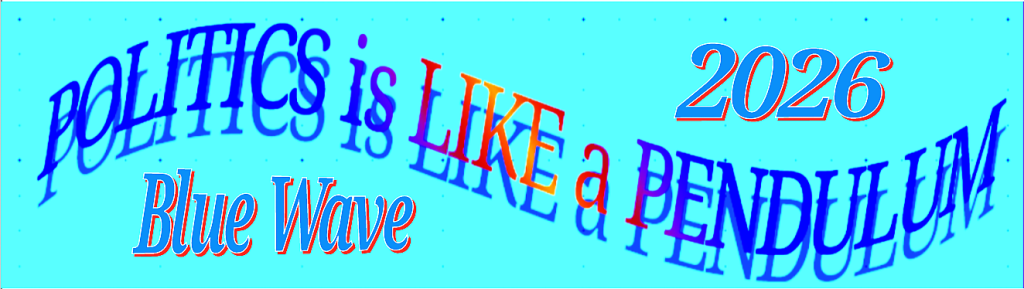
Politics is like a Pendulum Blue Wave 2026
Politics Swings Like the Pendulum Do
Pendulum Wave 2026
Blue Wave Pendulum 2026
Pendulum Power to the People 2026
Pendulum on a Spectrum of Love and Fear
Eventually the Pendulum Swings Back
The Pendulum is Swinging! 2026
Blue Tide Pendulum 2026
2026: The Pendulum Swings Blue
Pendulum Swings Between Tyranny and Anarchy
Swing Now Sweet Pendulum 2026
Oh! How the Political Pendulum Swings 2026
The Pendulum Will Swing Back 2026
REFERENCES, CITATIONS,
Grace Russo Bullaro, MAGA’s Cult-Like Grip Breaks America’s Political Pendulum – But for How Long? https://lavocedinewyork.com/en/politics-en/2025/10/15/magas-cult-like-grip-breaks-americas-political-pendulum-but-for-how-long/
Michael Brenes, What if the political Pendulum Doesn’t Swing Back?
Ed Palm: Will the pendulum swing back from extreme politics this time? https://www.kitsapsun.com/story/opinion/columnists/2024/12/14/if-history-is-a-guide-politics-will-swing-back-from-the-extremes/76953940007/
Diego Ruiz Sagrero: A Contest for Power: Why the Political Pendulum Theory May Not Hold Up
Jim Dunford, Mark Updegrove: Pendulum swings, cultural backlash and rhythms of democracy: What President Trump’s victory means for history https://current.org/2024/11/pendulum-swings-cultural-backlash-and-rhythms-of-democracy-what-president-trumps-victory-means-for-history/
Einstein Quote: Albert Einstein, The Human Side: Glimpses from His Archives (ed. Princeton University Press, 2013) – ISBN: 9781400848126, This is only reference found in AI search results.
The Swinging of the Political Pendulum: An Issue of the Anti-Authoritarian Playbook Newsletter Why the Pendulum Metaphor Fails, The Rachet Effect, Scot Nakagawa, political strategist https://politicalresearch.org/2025/07/15/swinging-political-pendulum#:~:text=%E2%80%9CRatchet%20effect%E2%80%9D%20refers%20to%20the,starts%20in%20a%20new%20place.
Arthur Schlesinger’s political pendulum, cyclical theory of American history: AI web-search Results
Liberal-Conservative cycles first identified in the United States or are specific to United States politics: https://en.wikipedia.org/wiki/Cyclical_theory_(United_States_history)
Schlesingers’ liberal-conservative cycle: Huntington’s Periods of Creedal Passion; Party systems and realignment elections; Klingberg’s extroversion-introversion foreign-policy cycle; Turchin’s long-term cycles; Modelski’s long cycles; Critical Response to Cyclical Theories; Sean Trende and Realignment Theory: https://en.wikipedia.org/wiki/Cyclical_theory_(United_States_history)
John Meacham proposes that pendulum cycles go to Extremes perhaps resulting in an AOC Presidency rather than centrist or moderate agency: https://www.youtube.com/watch?v=ngHbPVwdrJ0&t=6s
, PhD, Distinguished Fellow in the B. Kenneth Simon Center for American Studies at The Heritage Foundation: Is This the End of Conservatism As We Know It? https://www.heritage.org/political-process/commentary/the-end-conservatism-we-know-it First Appeared in The Washington Examiner, in it the Pendulum concept is co-opted for right-wing use.
Phillip A. Wallach: The pendulum is the pits: Can the United States make enduring regulations? https://www.brookings.edu/articles/the-pendulum-is-the-pits-can-the-united-states-make-enduring-regulations/ – Brookings Institute political analysis of trade regulations
Pendulum Wave Physics Toy: https://www.kiwico.com/diy/play-learn/sound-music/pendulum-wave-toy?srsltid=AfmBOorWSA9y2jvaoBARZbZIVPmXHj5A_Qk93xu04vDYRyGUIuTmEeTs • How To Make A Pendulum Wave (Science Exper… https://docs.google.com/spreadsheets/… • Pendulum waves animation + Explanation – Pendulum wave effect physics explained https://www.youtube.com/watch?v=7_AiV12XBbI – One of the most delightful demonstrations
Written, Compiled, Edited, Logo Design by
Fred Jay Ross, Independent Researcher
fredjayross@gmail.com, fredjayross.com January, 2026
https://fredjayross.com/ SITE NAVIGATION